The Wizarding World News
- Judges’ Picks
- Writing School with Ash
- Creative Corner with Hemlock
- Dear Severus Snape with Verity
- Competition Queries with Katie Alden
- Team Challenge with Lun
- League Table
Follow all important events of the International Wizarding School Championship here in the Wizarding World News. We also have a live Twitter feed, Facebook and an Instagram account for you to get day by day updates!
Judges’ Picks
We’ve decided this season to include a few words from our judges so that they might explain how they chose their judge’s pick. We hope this demystifies the process and gives everyone a greater chance of winning the award.
Year 1: Session One by thegoldensnitch102 DURMSTRANG
Classic romcom tactics and perfect comedic timing made this story a fun read. The characters made sense, and I especially loved the incorporation of Trelawney in the story.
Year 2: Purge Me With Hyssop by adavision ILVERMORNY
Captivating and enchanting, this story offers a glimpse into Snape’s life during the events of Deathly Hallows. It also explores the unexpected, yet charming friendship between Severus and Luna Lovegood. The poetic descriptions are sure to enthral readers.
Year 3: More Than Dirt by DrarryMadhatter ILVERMORNY
This wonderfully atmospheric story showcases many facets of life after the trauma of the Second Wizarding War, from prejudice and cruelty, to kindness and compassion. I loved the way the writer used Luna Lovegood’s unique perspective on life to convey the message that everything has worth, no matter how small.
Year 4: a rose without thorns by QuickSilverFox3 ILVERMORNY
With descriptions that will captivate you and figurative language that will stay in your mind for days, this story’s ability to capture the magic in the mundane highlights the relationship between two ‘side characters’ that truly deserve their moment in the spotlight.
Year 5: You Make My Dreams Crumb True by Leprechaun123 ILVERMORNY
The usage of puns and descriptions of the cupcakes ultimately sold me on this story. It delivered a realistic look at a characters’ ability to show what they cannot say via their actions.
Writing School with Ash
Writing Technique:
Raising the Tension
Tension generates reader interest. The more tension a story has, the less likely readers are to abandon or forget about it. So, let’s see about raising the stakes.
Find an objective.
I ended the last Writing Technique section by telling you to introduce a problem in your opening that your character has to solve. Finding that solution becomes your character’s main objective.
However, we all want many things, and so does your character.
Harry wants to defeat Voldemort, but he also wants to learn magic, play Quidditch, win the House Cup, etc.
For a one-shot, keep it simple and stick with one or two objectives.
Make it personal.
Your character’s objectives have to mean something to them. Why does Harry want to defeat Voldemort, learn magic, play Quidditch, and win the House Cup?
If your character doesn’t care, neither will your readers.
Make objectives personal by creating consequences. For example, Harry has to defeat Voldemort or else good people will die.
If your character cares about the consequences, they’ll work extra hard, and your readers will root for them.
Add obstacles.
Each objective creates new opportunities for conflict.
Readers will begin your story with the assumption that your main character will succeed. You need to make them doubt that.
Very little should come easily to your character and anything that does should have strings attached, like Harry’s skill at Quidditch worsening his rivalry with Draco. A story about someone with a perfect life, where every decision ends well and everything always goes to plan, won’t keep readers interested.
The more readers worry, the more invested they’ll be in the story’s outcome, so be mean. Take away what your character relies on, make them argue with the people they love, crush their dreams, whatever you can think to do.
Don’t go too fast.
Your character should experience moderate highs and lows with a few positive and negative spikes throughout the story.
They shouldn’t be miserable and fail all the time, but the closer you get to the story’s resolution the greater those negative spikes should become, both in number and severity.
Start with small obstacles and let them grow: Umbridge won’t teach Harry and his peers to defend themselves, so they create the DA, but she gains more and more power. When the DA is discovered, Dumbledore is forced to flee, so when Harry suspects that Sirius is in danger, he has no one to turn to. He takes action, thinking he’s going to fix everything, but it was a trap and Sirius ends up falling through the Veil.
The tension intensifies towards the end, building up towards the story’s climax, which is a result of Harry’s previous actions.
When your character has a decision to make, every option should have disadvantages. The action they decide on should lead to another decision, creating another problem and so on.
Include a ticking time bomb.
Running out of time is stressful, which you want the end of your story to be if you plan to leave a lasting impression.
There’s a ticking time bomb in all the Harry Potter books: Harry is convinced that Snape will steal the Philosopher’s Stone tonight. If Harry doesn’t act now, Ginny will die. Trelawney warns Harry that the Dark Lord’s servant will break free tonight, etc.
Create some inner conflict.
Your character should know what they want (their objective) from the beginning of the story, but what they need should only become obvious to readers as the story progresses.
Harry wants to defeat Voldemort and survive, but he needs to be the villain’s opposite: loving, loved, and self-sacrificing.
The best stories feature needs and wants that contradict each other and force the character to choose one and sacrifice the other, thus establishing a story-worthy problem. Which side will win and why? There’s generally an implicit moral in that question’s answer.
Returning to The Hunger Games example from the last WWN issue: Katniss wants to win the games so that she can reunite with her sister, but what she needs is to stop playing by other people’s rules, even if it means losing.
To figure out what your character wants and needs, check Maslow’s Hierarchy of Needs.
Think scene by scene.

Your story needs tension, but so does each scene because a scene without tension is boring: Harry wants to read his letter, but the Dursleys won’t let him. Harry wants to eavesdrop, but a loud noise makes him bang his head, and he gets caught.
Scene stakes can be little things or big things so long as you leave the biggest one for your story’s finale.
Remember that each scene’s objective should work towards your character’s story objective.
Don’t fear the reaper.
Remember what I said in the last issue? A problem that your character can walk away from makes for a story that readers can walk away from.
You need to make sure that a) your character has no choice but to see the story through, and that b) failure on your character’s part isn’t an option.
Death is the highest stake there is, but it doesn’t have to be literal.
Threatening your character’s life or the lives of their loved ones probably won’t work if you’re writing an office romance, but that doesn’t mean your story’s stakes can’t be high-risk.
Failure must mean losing something that is essential to your character. It can be anything: their self-worth, their purpose, their family, the respect of their community, etc. Losing that thing must break them beyond repair. That is the threat that hangs over your character throughout the story.
Grammar and Punctuation Section:
The Passive Voice
The ball was caught.
The passive voice focuses on the object that experiences the action rather than the subject who creates the action. An easy trick for spotting the passive voice is adding “by + subject” after the verb. If the sentence makes sense with the addition, it’s written in the passive voice.
The ball was caught by me.
A lot of writers use the passive voice accidentally, but some use it on purpose to create an illusion of formality that falls short in fiction because it’s circuitous.
The example I gave is a simple one, but the passive voice will needlessly complicate longer sentences.
The writing on the books’ spines was hidden beneath a layer of dust, but the dust was blown away by Lucy’s strong exhale as the stillness was disrupted by another bat taking flight.
vs
A layer of dust hid the writing on the books’ spines, but Lucy’s strong exhale blew it away as another bat took flight, disrupting the stillness.
The sentence that uses the active voice is shorter, less clumsy, and more direct. Its pacing is a lot smoother, and the active verbs make the scene more interesting.
The passive voice should not always be avoided; it should just be avoided most of the time. There are occasions when the passive voice is a viable option, such as:
When hiding the subject’s identity.
I was mugged.
If your character doesn’t know who the subject of the action is or doesn’t want to reveal their identity, use the passive voice.
Lawyers, politicians, businessmen, journalists, and academics often use the passive voice for that reason.
When the object or action is more important than the subject.
Lily and James were killed.
The passive voice emphasises the object and action and lets you leave out the subject so that readers’ thoughts turn to those affected by whatever action you’re describing.
When the subject is an unconscious entity.
I was drenched by the splash.
The subject of that sentence is the splash, but since the splash has no intelligence or intent, you can argue that it’s more interesting to focus on the object. In some cases, it may be but keep in mind readers’ preference for the active voice.
Challenge:
Write a ficlet with high stakes and an understanding of the passive voice.
Your story is not to be beta read by anyone other than you. This exercise is designed to help you improve, which can only happen if you aren’t relying on a beta reader to fix everything for you.
The upward word count limit for this challenge is 900 words.
Each school can submit only 4 writing school stories.
Please add an A/N at the end of your story with copies of the sentences you wish to be marked on for the Grammar and Punctuation Section.
Optional Prompts:
[Object] Bomb
[Occupation] Auror or detective
[Pairing] Remus Lupin/Nymphadora Tonks
Points breakdown:
| 2 points for participation |
| Writing Technique |
| 1 point for making the stakes personal. |
| 1 point for your main character’s actions being responsible for their troubles. |
| 1 point for including a ticking time bomb. |
| 1 point for making the stakes life or death (literal or figurative). |
| Grammar and Punctuation Section |
| 1 point for using the active voice everywhere but in the following sentences. |
| 1 point for using the passive voice to hide the subject’s identity. |
| 1 point for using the passive voice to add emphasis to the object or action. |
| 1 point for using the passive voice when the subject is an unconscious entity. |
| Deductions |
| -0.75 for SPaG errors. |
| -1 for submission errors. |
Creative Corner with Hemlock
The winner of last week’s crossover challenge is Leprechaun123 from Ilvermorny who showed off her embroidery skills with a Harry Potter/Once Upon a Time piece!
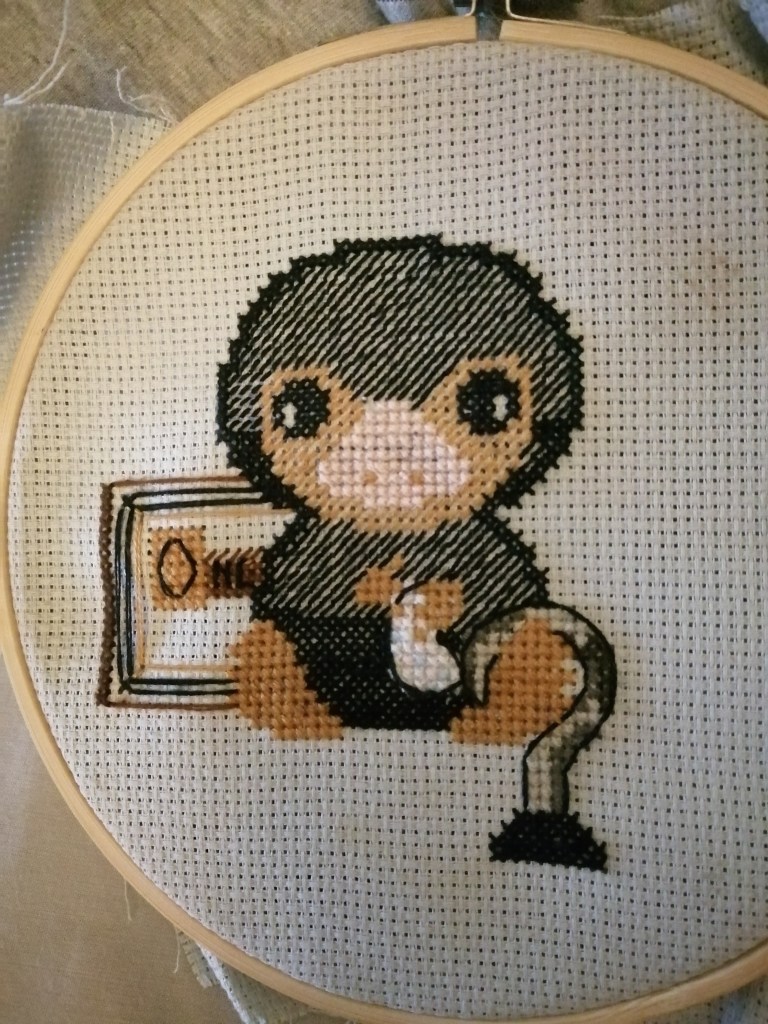
All throughout Storybrooke, things are going missing. It’s only an attempt to steal Rumple’s dagger that unmasks the invisible thief. But how can the residents stay mad at a creature with such a lovable face?
Genderbend
One of the great things about reading is that no two people imagine a character’s looks in the same way. The author supplies some of the information, and from that, we build a person. Gender is generally one of the first pieces of information authors share about their characters, but let’s say it isn’t.
What if some of us had imagined Harry as a girl and Hermione as a boy? It’s time to find out! I want to see what your favourite Harry Potter character would look like if they were a different gender.
- Pick your favourite Harry Potter character and change their gender.
- Use whatever artistic medium you want (haiku, cosplay, sculpture, drawing, etc.)
- 100 words max. Use wordcounter.net to check your word count.
- Fact sheets and descriptions are not artistic mediums.
- It should be your own work. No plagiarism!
- No more than 1 submission per student.
- No more than 3 submissions per school.
- Submissions with a profound lack of originality or effort will not receive points.
Each school is allowed 3 submissions. Each submission will receive 3 points, and the winner will earn an extra 2 points. Deputies will vote for their favourite submission (excluding submissions sent by their school). Heads and admins will only vote to break a tie.
Dear Severus Snape with Verity
Welcome to another edition of Dear Severus Snape.
I have been forced to apologise for comments made about works of fantastical fiction written by a number of IWSC writers. In my humble opinion, if you paid more attention to your portrayal of sophisticated and complex characters, such as myself, you would not need to receive such scathing reviews.
In this issue, we will be tackling your familial troubles. I have been forced to deal with many issues within my own family, but I was able to overcome and grow into an emotionally healthy and well-adjusted adult. It is for this reason that I am the perfect person to dole out solutions to all your family troubles.
Dear Severus Snape,
I’ve found myself in a bit of a sticky situation, and I am in desperate need of advice.
Over the Christmas hols, my mother introduced me to her new suitor. He’s actually rather nice, knows a lot about Quidditch, and talks to me like I’m a person, not an annoying child. I think he would be a decent stepfather.
However, if they were to marry, he would be my mother’s fifth husband; the previous four died under mysterious circumstances. I hate to think badly of my mother, but really, four dead husbands seems a bit suspicious.
My question is this: do I warn this new man of his increasing likelihood of becoming past tense or do I say nothing and hope my mother won’t kill this one too?
Sincerely,
Child of a Black Widow
Dear Child of Black Widow,
Don’t get attached. We all know who your mother is and what she has done. I highly doubt they will catch her this time, but if they do, you might get to keep a father for a change.
My condolences, whichever way this goes
Professor Severus Snape
Dear Professor Snape,
Help! I’m the first Weasley in generations to have been sorted into Slytherin. What can I do to stop the constant Howlers from my family?
From the red-headed student with singed eyebrows
Another Weasley!
Are you a sleeper agent? You should know, the last one was never the same again.
Unfortunately for you, I imagine your family will keep up the ruse by sending continued Howlers. It cannot be helped.
Professor Severus Snape
Dear Severus Snape,
I’m so very sorry to ask, and I mean this with the utmost respect because you are a knowledgeable professor and an accomplished duelist. Why did you never have a family of your own? Was there…something holding you back, perhaps? Once again, no offence intended, so sorry, have a good day.
Sincerely,
A Nobody
Dear Nobody,
How do you know I don’t have a family? How do you know there isn’t a hero in the wizarding world I could have an “I am your father” moment with? You don’t know my life!
Professor Severus Snape
Dear Severus Snape,
I have recently adopted a child. He says his role model is Tom Marvolo Riddle. I don’t know who that is or why my child seems to be in love with this strange man, but do you have any advice on how to handle this?
Thank you in advance,
Puzzled and Perplexed
Dear Puzzled and Perplexed,
Tom Marvolo Riddle was the Dark Lord you imbecile!
Look what you did. I have used frivolous punctuation now.
Professor Severus Snape
Dear Snivellus,
I have a very serious problem, and I’m looking for your sage advice. Since you claim to be the expert on all things family, I’m curious to know how you would handle the transition to becoming a parent.
Why, you may ask?
Because Lily’s pregnant! Sorry, the role of godfather has already been assigned. We’ll keep you in mind for the next one, though!
Your very best of enemies,
Potter
PS: It’s Potter Sr. now.
Potter,
I already knew. Lily told me last night, and I made sure to let her know you were too childish to ever make a decent father, and then I took her to my bed.
Who knows who the father is, but if it is you, don’t worry; you won’t mess up the sprite any worse than you already have by perpetuating the gene pool.
Your Sincerely
Professor Severus Snape
In the next instalment of this horrid article, I will be using the skills I have acquired as Hogwarts’ greatest professor. Send me anything and everything about school and homework. You’re all dunderheads and need all the help you can get, so I shall graciously provide it. There’s 1 point per submission, you can send an email or an owl to my fanfiction account here.
Competition Queries with Katie Alden
Teamwork
Here at the IWSC, we believe teamwork is important.
Working as a team has huge benefits. It builds relationships, and you can almost always achieve more together than you can apart. However, teamwork isn’t always easy, especially online, working with people you have never met face-to-face. So, here are my top tips for teamwork in the IWSC:
- Make sure you are on the same page. If you haven’t already, I recommend setting up rules on which the team has agreed. People are more likely to follow rules that they have had input on, and doing this as a team will help you come together and share what is important to each of you.
- On that note, share your goals for the competition with your team. Are you here to win? To get better at writing? To make new friends? Knowing where everyone stands early on will help to avoid conflict. You can also develop some team goals, which may get worked into your rules. Some examples are:
- Every story gets a minimum of three betas.
- All stories must be submitted 24 hours before the deadline.
- At least 2 Creative Corner entries per round.
- Everyone shares one funny story per week.
These goals don’t have to be competitive. Something as simple as sharing a new fact each week can help to bring the team together.
- Communicate with your team what you will give and what you expect of others. If you know that you can’t do more than write the main story and do one extracurricular per round, make sure the rest of your team knows. If two team members expect everyone to do everything, and the others are aiming for one extracurricular each, there will be tension within the team. This feeds back into tip one. This point isn’t just for the beginning of the competition—if you know that you will have a busy week, let your team members know what you can complete ASAP.
- Never expect others to do more than you do yourself. There will always be people who do more than others, however, if you are not willing to do something, do not expect others to do it. For example, if you are unwilling to beta for others, you can’t get upset if others don’t beta for you. You should think of this less as “I won’t do something unless others do it for me,” and instead as “what would I want done for me, so that I can do the same for the rest of the team.”
- Remain respectful, always erring on the side of caution. Different people have different thresholds as to how much teasing and banter they can tolerate. This is difficult to convey in a text-only medium such as discord or forums. If you are unsure how something might be taken, don’t say it. If you accidentally upset someone, apologise. Remember that respect doesn’t mean you have to agree with someone, but that you should not be putting down their beliefs, opinions, or things that are important to them. If I tried to tell you that all of the headmistresses have the same views on everything, you would be right to laugh in my face. But when we disagree, we don’t say, “well, that’s stupid,” or “I can’t believe you actually think that.” Instead, try phrases like “I hadn’t thought of it that way before,” and “I can see how you came to that conclusion. Here is my take on it.”
At the end of the day, we do not expect everyone in the IWSC to become best friends. However, we believe that by working together as teams everyone can have more fun and better themselves as writers.
If you have more teamwork tips that I haven’t included, why not share them in your team server and/or Honeydukes so that we can all benefit. After all, the IWSC really is just one big team!
Team Challenge with Lun
First off, well done to all five teams for completing the trivia challenge in issue 1! We picked a winner at random, so congratulations Beauxbatons! The winning school receives an extra 4 points.
Magical Murder Mystery
This season, Headmistress Lun has written a Magical Murder Mystery instead of the puzzles you are used to. There are three parts, alternating with Puzzles (the tasks will be published in the WWN in rounds 2, 4 and 6).
The puzzle is meant to be solved as a team effort: Each team can hand in their answers. If all riddles are solved correctly, the team can continue on the next puzzle in the following round of the Magical Murder Mystery.
Among all teams that hand in the correct answers without requesting hints, one team will be selected at random and win 5 points and will get additional prompts in the next round. The other teams that solved the riddles without hints will also get those additional prompts.
If you need hints to solve the riddles, you can ask your head. But beware! You will not get any additional prompts in the next round of the competition and you will not be able to win 5 points. Without sending in the correct answers, you can not continue with the next round of the Magical Murder Mystery.
How to participate:
The Murder Mystery is written in the 2nd person, so you will play as a character in the story. To participate, invent a character with your teammates. This character joins the Auror department as a new recruit.
One representative of the team should send the character’s name to the competition email. No further background info or characterisation will be needed, but feel free to write up to 100 words of your character or send in a picture to be published in the WWN (no points attached).
INTRODUCTION
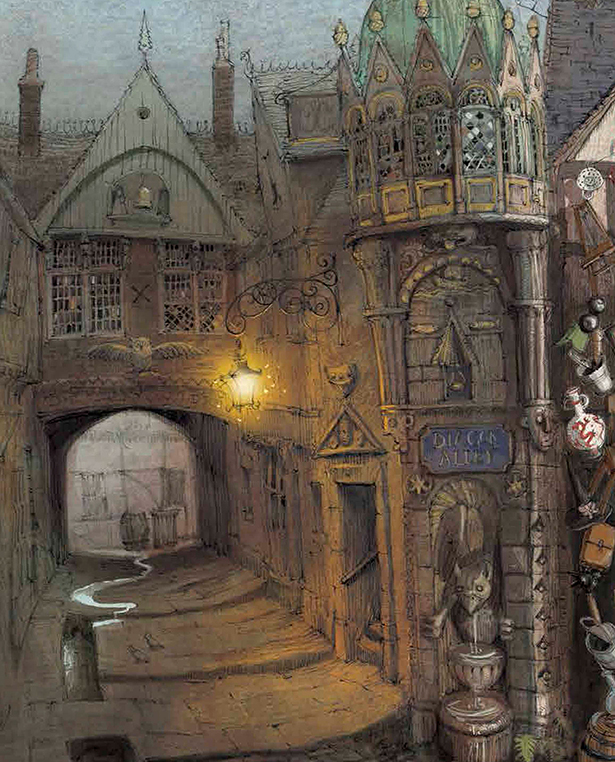
Head Auror Potter takes you to a crime scene at Diagon Alley. Auror Weasley is already taking witnesses’ details and Auror Granger is desperately trying to shoo away Prophet Reporter Colin Creevey and his flashing camera.
This isn’t just any crime scene; it’s murder!
“This will be impossible to solve without support, boss,” Auror Weasley informs his superior. “Too many clues leading in different directions. We don’t have enough investigators with all that’s going on with the Knockturn Alley drug trade…”
Head Auror Potter nods. “Luckily, we just got a bunch of interns to do the legwork.” He looks at you and gives you an affirming nod. “If you want to make it in our department, you have to start small. Report your findings to the competition email to get further instructions.” Turning to Auror Weasley, he orders, “Fill them in on the clues we have. I expect results on this soon.”
PART ONE
Find out these details about the case:
- Victim:
- Cause of death:
- Witnesses:
Report the answers back to the competition email to get further instructions from Head Auror Potter. Each school sending correct answers will get additional prompts in the next main round.
If you want to continue in the next round, you have to send in the correct answers. You can request hints from your headmistress if you are stuck, but you will lose the chance to win points and will get no additional prompts for the next main round.
1. VICTIM:
Auror Weasley has terrible handwriting and uses Auror-lingo that is hard to decipher. You are left to figure out what his notes on the case mean.
Tip: To solve the riddle, find out which famous encryption method the code refers to. You are allowed to use Google 😉
Case: Diagon 6, Code: Backstabbed in Rome
zlh imezms my nbelbxmby ysmzl
2. CAUSE OF DEATH:
The forensic witch speaks in riddles. Figure out what she means to guess the cause of death.
There are two things involved in the cause of death. One is associated with a person, the other with a place:
The person was hated and feared, severe is their first impression. The skill they had mastered was the cause of death.
The place is one of youthful exploration where children first arrive for a new step in life, where leisure time is spent, first love is discovered, and haunted places are visited. Now take away the animal, and you will know how death was delivered.
3. WITNESSES:
The first witness’s name is Gary, but the name and address they gave don’t match up with the Ministry’s records. It turns out they gave Auror Weasley a false name. You are left with the short description your colleague noted down about them:
The first witness is perfect through and through. They find their way into many stories across all fandoms, haunting new writers like a ghost. The false name they gave is a clue to their real one.
The second witness goes by the name of one of our Headmistresses. She chose her pen name after one of her first OCs.
The International Wizarding School Competition League Table
| School | Place | This Round | Points | MVP |
| Ilvermorny | 1 | 182.75 | 182.75 | QuickSilverFox (40.5) |
| Beauxbatons | 2 | 172.5 | 172.5 | Lady Sloane (32.25) |
| Hogwarts | 3 | 171 | 171 | Adenei (37.25) |
| Durmstrang | 4 | 122.5 | 122.5 | Keepsmiling (33.75) |
| Mahoutokoro | 5 | 77.5 | 77.5 | Kokoro (20.75) |

Feel free to contribute to other aspects of the paper by sending a private message to the Competition account. We are always looking for pieces of fanart and even your thoughts or recommendations. Even if you want to send a message to someone in the competition that you think has excelled, or maybe they helped you out? Send it to Aunt Molly! Anything else should be sent to Wizarding School Championship. The subject line should be “Wizarding World News: [Name the section of the paper you are writing about]”.
 Wizarding World News