Q
Do you have any tips for keeping control of plots? One time I tried to write a longer story, but when I got to writing the eighth or ninth chapter, I’d forgotten the important points I brought up at the very start.
A
There are three types of writers: the plotters, the pantsers, and the hybrids. It sounds like you’re one of the latter two, probably a hybrid.
Plotters plan their stories down to the smallest detail. Before they start the first chapter, they know exactly what’s going to happen and when.
Pantsers don’t plan. They start with a character, setting, or action and let that element take on a life of its own. Pantsers sit down and write, flying by the seat of their pants.
Hybrids are the grey area. They have an idea of where their story is going (the amount of detail varies from one writer to the next), maybe they have a few scenes planned out, but what happens between those scenes is more or less a mystery until they start writing.
Keeping control of plots is easy for plotters. Their downfall is in keeping too tight a hold. If they don’t give their characters, settings, and events room to breathe and grow and instead force them to fit predesigned roles, their story will suffocate.
That kind of suffocation isn’t a problem from pantsers because there’s no control. They dive into the dark with a single flame and hope there are sconces along the way that they can find and light. The pantser’s undoing comes when they don’t find any or enough torches to shed light over their story. The characters lose their way and the plot meanders uncertainly.
Depending on their shade of grey, hybrids face both problems to varying degrees.
From what you’re saying, it seems like you found some torches when you started writing, but you’ve moved forward and now those flames are too far away to see. It’s not a problem.
You have two options:
a) carry on as a pantser, keep writing, and know that you can edit when you’re done, or
b) become an organised hybrid.
If you prefer option b, the thing to do is to take notes while you write. Read your story from chapter 1 and have a notepad, index cards, corkboard, or digital spreadsheet at hand so that you can write down important points and details you want to remember. Here’s a spreadsheet example:
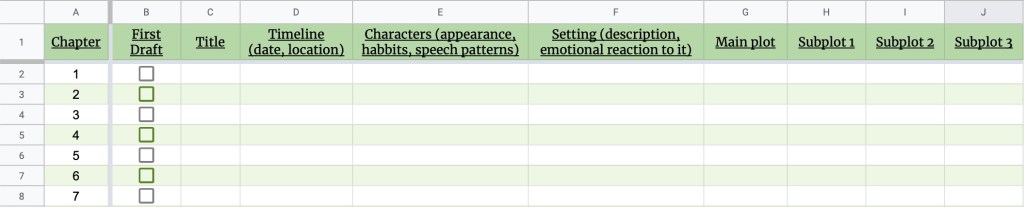
It can become a lot of work, and it’s time spent productively procrastinating instead of writing, so you may actually prefer option a, in which case, finish your first draft, then worry about your story making sense (you can use the spreadsheet method when you edit).
Your first draft is allowed to be terrible and not make sense. In fact, I recommend it. The purpose of the first draft is to get your story finished; quality comes into play when you edit. Plotter, pantser, or hybrid, when the time comes to turn your first draft into a second draft, you will know how your story evolves and where it ends. From there, all that’s left to do is edit and fix your story’s consistency.
Get it down. Take chances. It may be bad, but it’s the only way you can do anything really good.
WILLIAM FAULKNER
 Wizarding World News
One thought on “Do you have any tips for keeping control of plots?”